
WTWilly Tai
Ledger Notes · No. 1 · 2026Case study + Commentary

Put the model around the number, not in it: where AI actually earns its place in sustainability reporting.

First-wave CSRD preparers say their biggest burden is not data volume but interpretation, judgement and evidence: the soft costs no reporting platform touches. Meanwhile, not one independent study shows AI fixing any of it; every effectiveness claim traces back to a vendor selling the tool. That gap is the opening. The IAASB has already written the auditability bar for AI in this workflow, so the winning move is to build to that bar and prove it. This piece walks through a working platform that does: probabilistic AI at the edges as gated proposals, deterministic arithmetic at the core, every figure re-derivable on click. Built and demonstrated on a synthetic estate, not delivered for clients.

GreenLedger runs locally: Python stdlib and vanilla JS, zero dependencies. seed.py builds the estate from a fixed seed; api.py serves it; the test suite passes 40/40. A third party re-running the seed gets byte-identical data, identical verdicts, identical hashes. The evidence pages that follow, with the full pain-point analysis, are in the companion commentary: Five pain points in ESG reporting, and where AI actually helps.
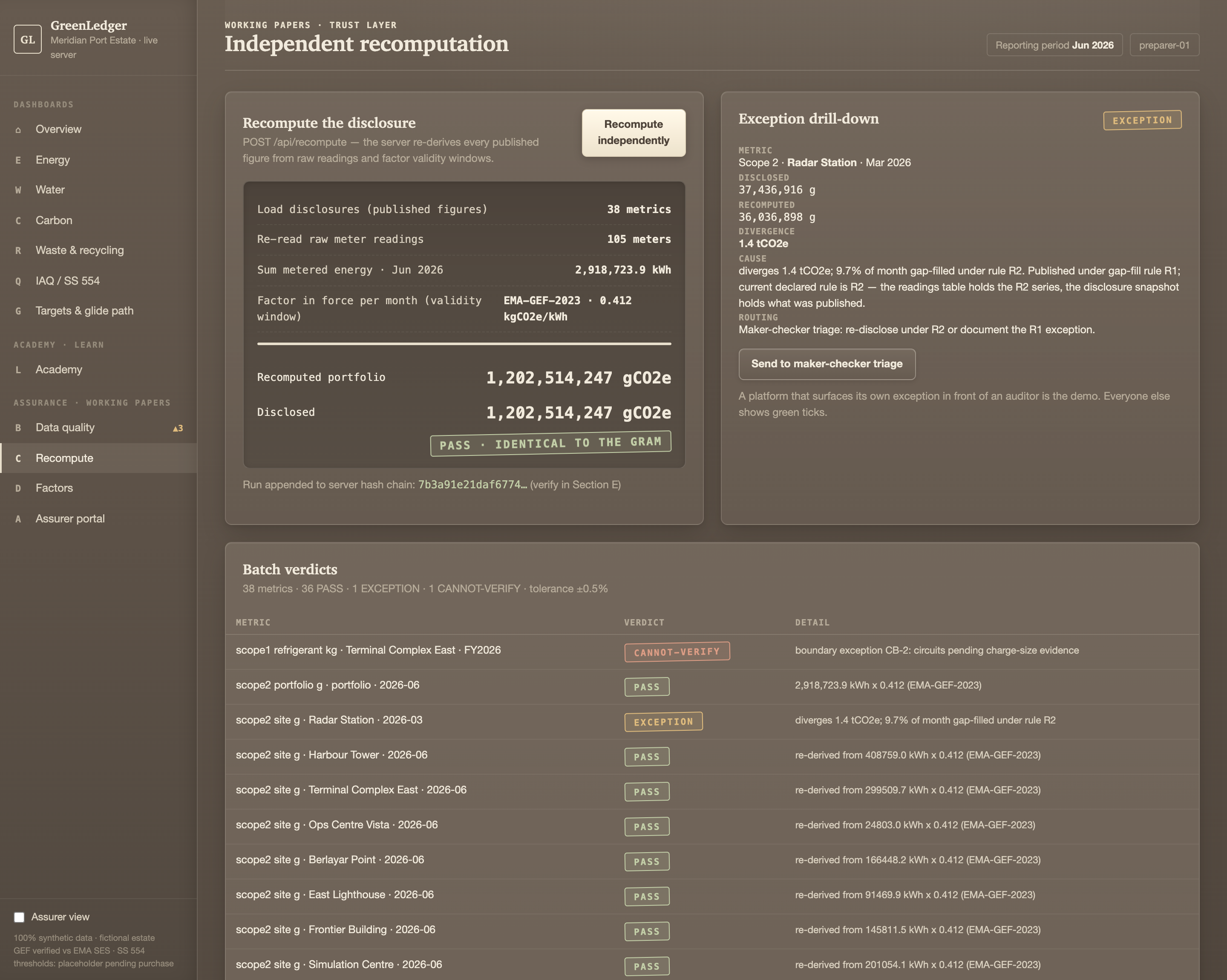
GreenLedger recompute screen: 38 metrics, 36 PASS, 1 EXCEPTION, 1 CANNOT-VERIFY at ±0.5% tolerance, with the exception drill-down showing a 1.4 tCO2e divergence and its cause
Exhibit 1. The platform recomputes all 38 disclosed figures and surfaces its own 1.4 tCO2e exception before the assurer asks.
Meridian Port Estate · synthetic data, seeded faults declared · GreenLedger local build, Aug 2026

01 / The interpretive burden

The burden is interpretive: understanding the standards alone ate 15% of implementation cost.

EFRAG's cost-benefit study of first-wave CSRD preparers ranks the top three burdens as interpreting the standards, collecting value-chain data, and the double materiality assessment. Reducing the number of data points, the fix most simplification debates reach for, ranks only fourth. Respondents reported that simply understanding what the standards require consumed 15% of internal implementation cost; 89% rated the effort high or very high, with no company reporting low effort; and the median bill came to roughly EUR 500,000 internal plus EUR 300,000 external, about half of it recurring annually. [EFRAG, Dec 2025, verified 3-0, burden ranking 2-1; 43 Wave 1 respondents, self-selected, commissioned alongside a simplification consultation, so these read as what respondents reported, not population estimates]

Reporting platforms assume you already know what the standard requires: they give you fields to fill, not answers to "does this paragraph apply to a leased building?" The largest soft cost in the regime is a retrieval problem, the most AI-addressable line item in the entire dataset, and almost nothing on the market addresses it. The honest version of that layer quotes the corpus and cites the module and section it drew from, and when the text does not cover the question, it says so instead of inventing.

Ask the Academy answering a refrigerant measurement question by quoting the curriculum with a module citation
Ask the Academy returning NOT COVERED for an out-of-corpus question about TCFD scenario analysis
Exhibit 2. The interpretation layer quotes and cites the curriculum or says not covered. It never invents.
Meridian Port Estate · synthetic data · GreenLedger local build, Aug 2026 · left: in-corpus question, quoted and cited · right: out-of-corpus question, honest refusal
02 / Finance data as sensor

Your best Scope 3 sensor is the general ledger, and the IAASB has already published the audit bar for mining it.

The general ledger already contains most of Scope 1 and much of Scope 3: captured, structured, and audited for another purpose. A classifier that maps ledger and spend lines to emission categories converts finance data into activity data. The IAASB's ISSA 5000 implementation guidance treats this very setup, a carbon platform interfacing with the general ledger and auto-assigning emission factors to expenditure lines, as a control point with two questions attached: is the factor database appropriate, and does the assignment process work. [IAASB implementation guidance, verified 3-0 on source content; extending it to AI classifiers is my inference] The standard-setter wrote the test before we wrote the code.

GreenLedger's classifier is deterministic and explainable: rules with weights that produce a plain-English rationale, a confidence score, and a proposal that a named human confirms or rejects. Ownership is the part text-mining cannot decide, so it does not try: the boundary register, which records who holds operational control, decides whether a diesel invoice is our Scope 1, a customer's cost, or a documented exclusion. A language model slots in above the unmatched rows as one more proposer behind the same human gate, which is the architecture the IAASB worked example expects to find.

Ledger classification queue showing proposed scope, confidence, ownership and flags per payment line, including a customer-attributable diesel invoice marked not our Scope 1/2
Exhibit 3. The classifier proposes; the boundary register, not the invoice, decides whose emission it is.
Meridian Port Estate · synthetic data · GreenLedger local build, Aug 2026 · note INV-4488: same vendor and fuel as INV-4471, routed out of Scope 1 because the cost was incurred for a customer
03 / The controls gap

92% of assured sustainability data has never been tested to audit depth: the gap is controls, not dashboards.

The arithmetic is worth doing in the open. In FY2023, 82% of sustainability assurance engagements were limited assurance and only about 8% reasonable, with nearly two-thirds of that reasonable work covering GHG metrics alone. Everything outside the reasonable slice, roughly 92% of assured sustainability data, has never been tested to audit-equivalent depth. Provider quality divides the same way: non-audit providers signed 45% of assurance reports that year, yet only 38% of them applied ISAE 3000, against 98% for audit firms. [IFAC/AICPA, FY2023 data, verified 3-0; superseded by the 2019-2024 edition, and the non-audit share has since receded to roughly 41%]

The cost hides off the fee line. Internal assurance effort runs at roughly 25% of external assurance fees for large preparers, and some interviewed companies reported one internal hour for every external one, friction attributed to ambiguity in the standards. [EFRAG interviews, Dec 2025, verified 2-1] The double materiality assessment alone consumes 20% of internal implementation cost, as much as preparing every disclosure. [EFRAG, verified 3-0] ISSA 5000 itself concedes that entity controls over sustainability information "may often be less than fully developed". The conclusion practitioners keep re-learning: evidence has to be assembled at the moment the number is created, because by fieldwork it is archaeology.

92%
of assured data never tested to audit depth
Derived: 100% minus the ~8% reasonable slice. IFAC/AICPA FY2023.
25%
internal effort vs external assurance fees
Some preparers at 1:1. EFRAG interviews, Dec 2025.
20%
of implementation cost is double materiality
Equal to preparing all disclosures. EFRAG, Dec 2025.
38%
of non-audit providers applied ISAE 3000
Audit firms: 98%. IFAC/AICPA FY2023.
Completeness scan at 96.7% coverage with findings that each name the independent witness expecting data: asset register, general ledger, meter registry
Exhibit 4. Completeness is triangulated across five independent witnesses, and each finding names its witness.
Meridian Port Estate · synthetic data, seeded gaps declared · GreenLedger local build, Aug 2026 · 118 of 122 expected sources answered; the fuel-card payment with no activity record behind it is the general ledger acting as a completeness witness

04 / Estimates at the size of the answer

Modelled Scope 3 estimates are wrong by roughly the size of the answer.

Where measurement stops, the numbers stop agreeing. Two major Scope 3 data vendors agree on only 68% of data points within 1% error, and model-estimated data matches neither vendor on any data point. Six major ESG rating agencies correlate at between 0.38 and 0.71, averaging 0.54: divergence, not error, but divergence investors can see. For FY2023, 82% of GHG-reporting large listed companies disclosed any Scope 3 at all, and purchased goods, usually the biggest category, was covered by 65%. [peer-reviewed Scope 3 data-quality study and Berg et al., both verified 3-0]

111%
Trimmed mean absolute percentage error of model-estimated Scope 3 data against either measured vendor dataset. The estimate is wrong by roughly the size of the answer.
Peer-reviewed Scope 3 data-quality study · verified 3-0

The useful response is to shrink the estimated share: extraction from documents, meter and sensor capture, anomaly detection that notices when a series stops behaving like measurement. Whatever estimation remains gets labelled at ingestion with a declared fill rule, visible in the lineage of every figure it touches, and is never silently promoted to a measurement. In Exhibit 1 the exception exists because a gap-fill rule changed mid-quarter and the platform refused to paper over the difference.

05 / The negative finding

Nobody has proven AI works on any of this, and that is the strategic opening.

In an adversarially verified research pass, every claim that AI is currently reducing ESG reporting effort traced back to a vendor selling the tool the claim validates. No independent evidence survived. Nothing from practitioner-anecdote channels survived verification either. That is an absence of independent evidence, not evidence of absence.

That finding is why this platform is built the way it is. If nobody can yet prove AI effectiveness in this workflow, the system that wins is the one that produces the proof by construction: every model action is a proposal carrying its inputs and confidence, a named human resolves it, the ledger records both, and the figure remains re-derivable by arithmetic with no model in the loop. The honest claim available today is not "our AI cuts reporting effort by X%", which nobody can substantiate. It is "here is where the model is allowed to stand, what it proposed, who approved it, and the arithmetic behind the number." Provability is the product, and the differentiated position belongs to whoever first demonstrates AI under the auditability bar the IAASB has already written.

06 / The architecture

The architecture that survives assurance: AI at the edges, determinism at the core.

Probabilistic components propose. Humans decide. Arithmetic discloses. The ledger records all three. Every disclosed figure can be re-derived without a model anywhere in the path, and when evidence is insufficient the verdict is Cannot-Verify, a first-class outcome, never "probably fine". The one place a language model touches words that matter, drafting the negative-form conclusion, is template-quarantined: the verdict is already decided before any wording is drafted.

EDGE IN · PROBABILISTIC · PROPOSES ONLY Document intakebills, delivery notes, tickets Ledger classifierGL lines → emission categories Completeness scanfive witnesses, chases ranked Human gate confirm · reject named, dated CORE · DETERMINISTIC · NO MODEL, EVER Calculation engine activity × versioned factor Boundary register whose emission it is Factor library validity windows, maker-checker RECOMPUTE VERDICTS: PASS · EXCEPTION · CANNOT-VERIFY EDGE OUT · CITE OR ABSTAIN Controlled answers quote the corpus, cite the paragraph, or "not covered" Drafting, gated wording only, after the verdict is decided CONTROL PLANE · SHA-256 HASH-CHAINED LEDGER, APPEND-ONLY Every proposal (model, inputs, confidence) and every decision (who, when, why) is chained; the figure re-derives from this record. ANYONE CAN PUT A MODEL INSIDE THE NUMBER. THE VALUABLE MOVE IS PUTTING IT AROUND THE NUMBER AND KEEPING THE NUMBER PROVABLE.
Exhibit 5. Every AI action is a proposal; only arithmetic produces the disclosed number.
Author's framework · the edges-and-core principle, as implemented in the GreenLedger reference build

The factor-vintage judgement, the sharpest single case of "AI must not decide this", has its own interactive demonstration: the GHG Assurance Workbench. Swap the factor vintage yourself and watch two metrics cross the modified-conclusion line while the uncited factor abstains to Cannot-Verify. It runs in your browser: no network, no data leaves the page.

07 / The walkthrough

What this looks like built: GreenLedger's answers to the pain points, working.

All figures in this section are from the synthetic Meridian Port Estate; the faults are seeded and declared, so detecting them demonstrates the mechanism, not a detection rate.

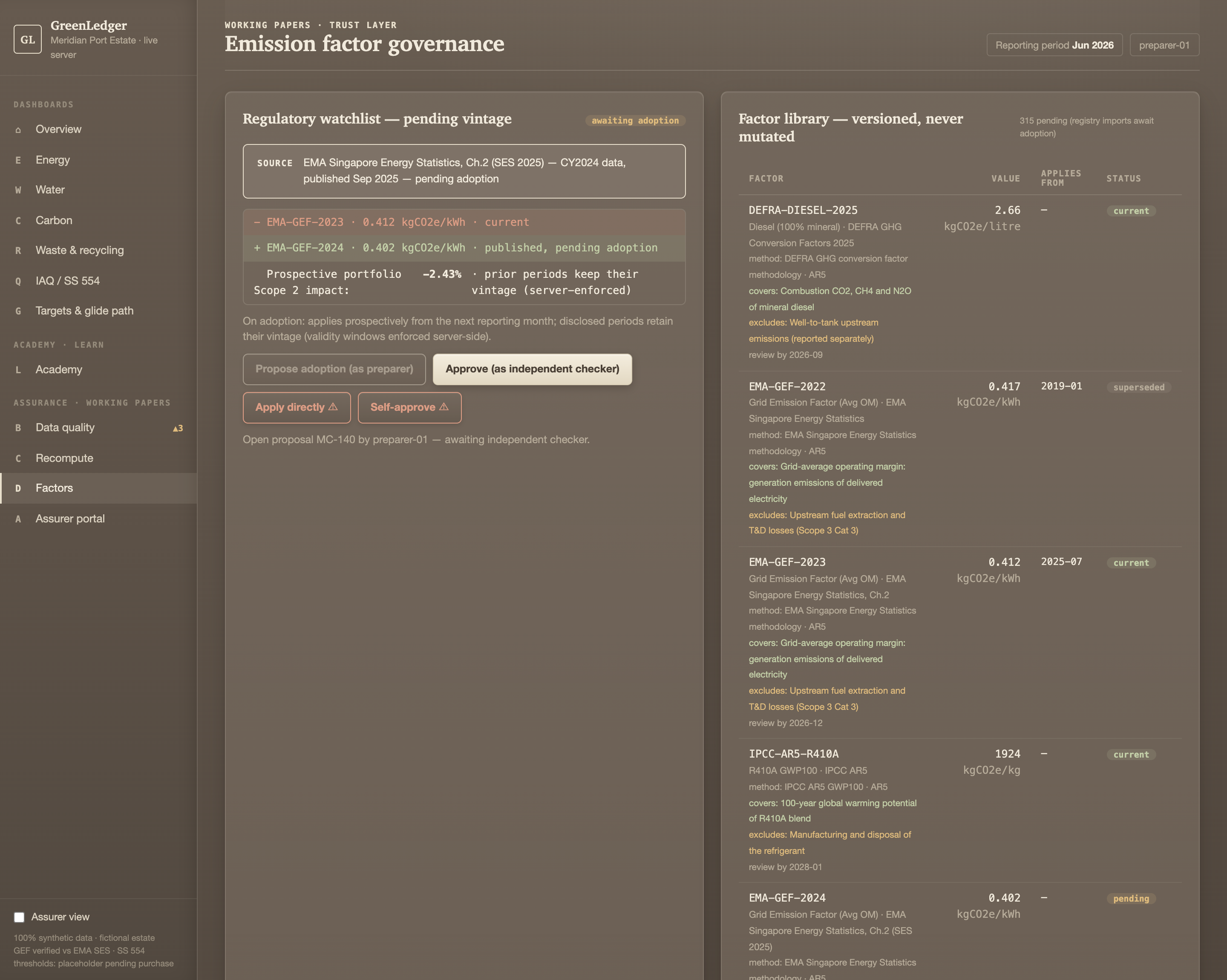
Everything above lands somewhere concrete in the build. Interpretation is Exhibit 2's cite-or-abstain layer. Ledger mining is Exhibit 3's classification queue, with the boundary register deciding ownership. Completeness, the assertion you cannot sample your way to, is Exhibit 4's five-witness triangulation. Factor governance is a maker-checker event history: adopting a new vintage requires an independent checker, applies prospectively, and never rewrites a disclosed period, because history is immutable and recomputable.

Factor governance screen with an open adoption proposal awaiting an independent checker, and a versioned factor library with validity windows and review-by dates
Exhibit 6. Adopting a new factor vintage is a maker-checker event, and it never rewrites a disclosed period.
Meridian Port Estate · synthetic data · GreenLedger local build, Aug 2026 · proposal MC-140 open, self-approval refused by the server, registry imports land as pending
The piece most platforms miss entirely is the review loop, so here it is in engagement mechanics. The assurer role is read-only over client data but writes review notes, because those notes are the assurer's own work product. Marking a sampled item anything other than verified requires a note explaining the conclusion. The preparer answers from their own screen. Both sides of the exchange are hash-chained. Evidence flows one way; comfort flows the other.

Assurer portal in read-only mode: a sampled recompute exception marked flagged with its mandatory note, a completed preparer exchange, and the verified hash-chained audit log
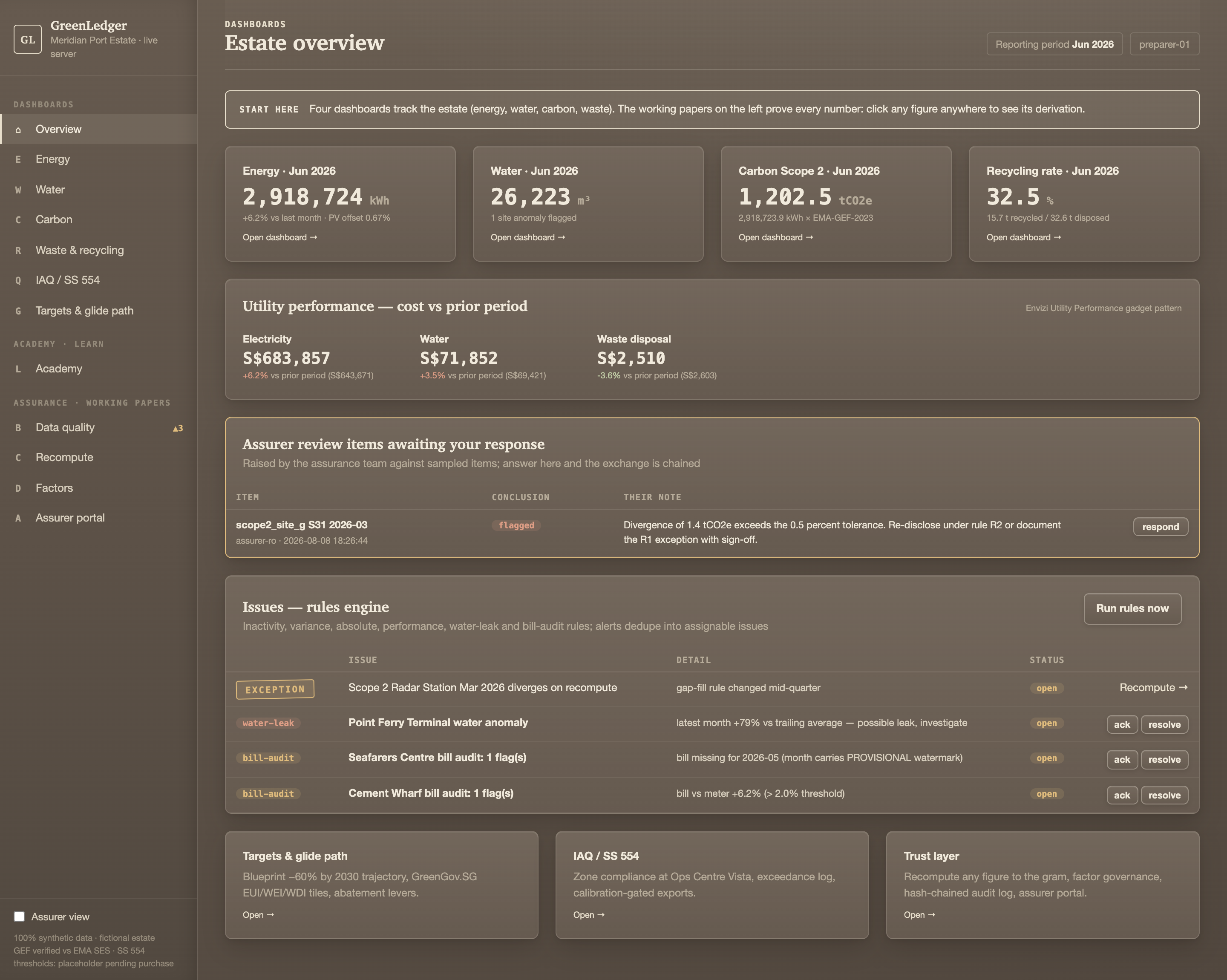
Preparer overview showing the assurer review item awaiting response, with the assurer's note and a respond action
Exhibit 7. The assurer flags, the preparer answers, and both sides of the exchange are chained.
Meridian Port Estate · synthetic data · GreenLedger local build, Aug 2026 · left: assurer session, READ-ONLY chip bottom left, chain verified at 18 entries · right: the same flag arriving in the preparer session, no reseed between frames
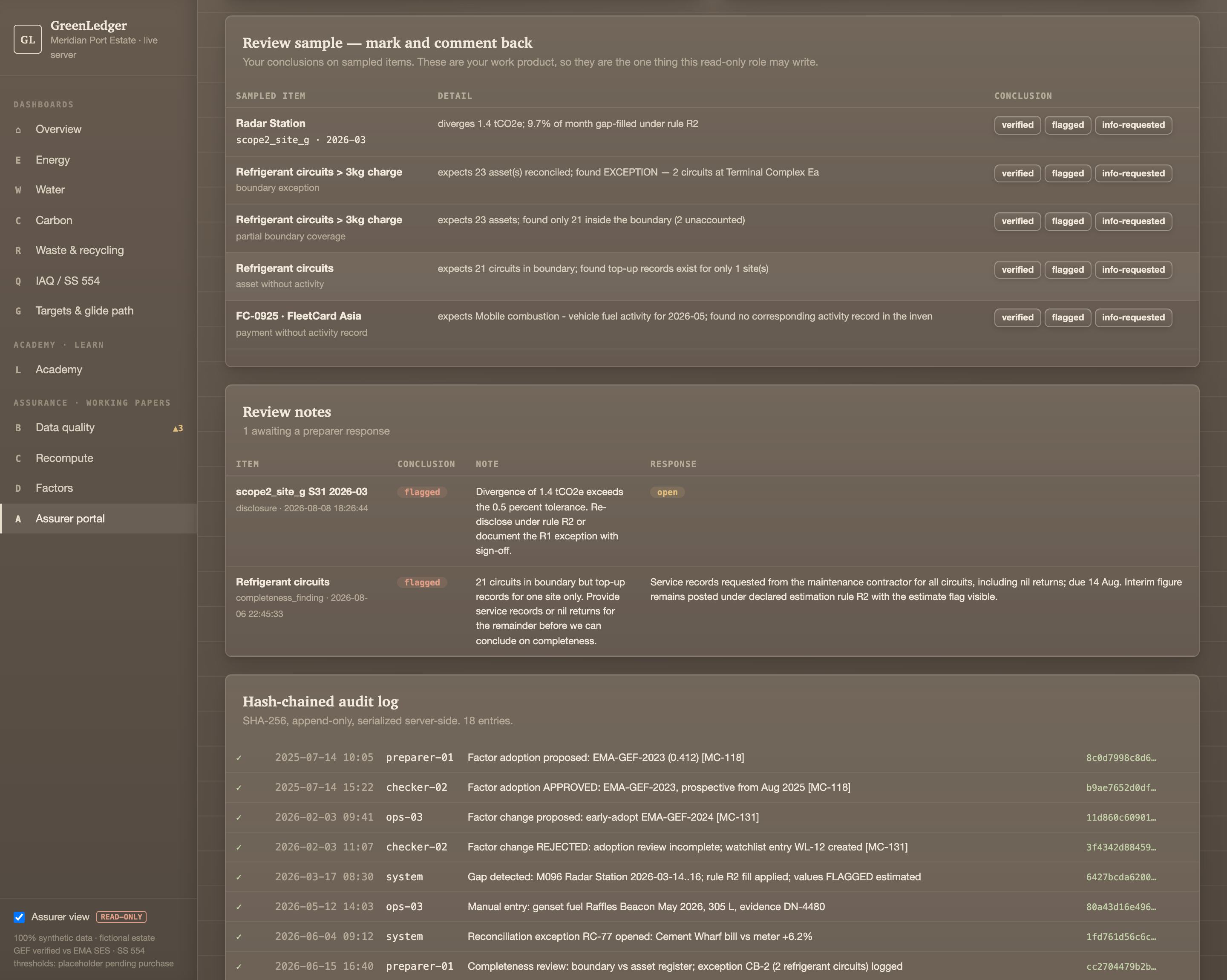
Exhibit 7b. The two interactions a still cannot prove: the review-loop round trip, and validation refusing a bad file then accepting a clean one.
Screen recording, muted, captioned · Meridian Port Estate · synthetic data · GreenLedger local build, Aug 2026
08 / The wedges

The category's real weaknesses are months-to-value and a one-way audit trail, and both are demonstrable.

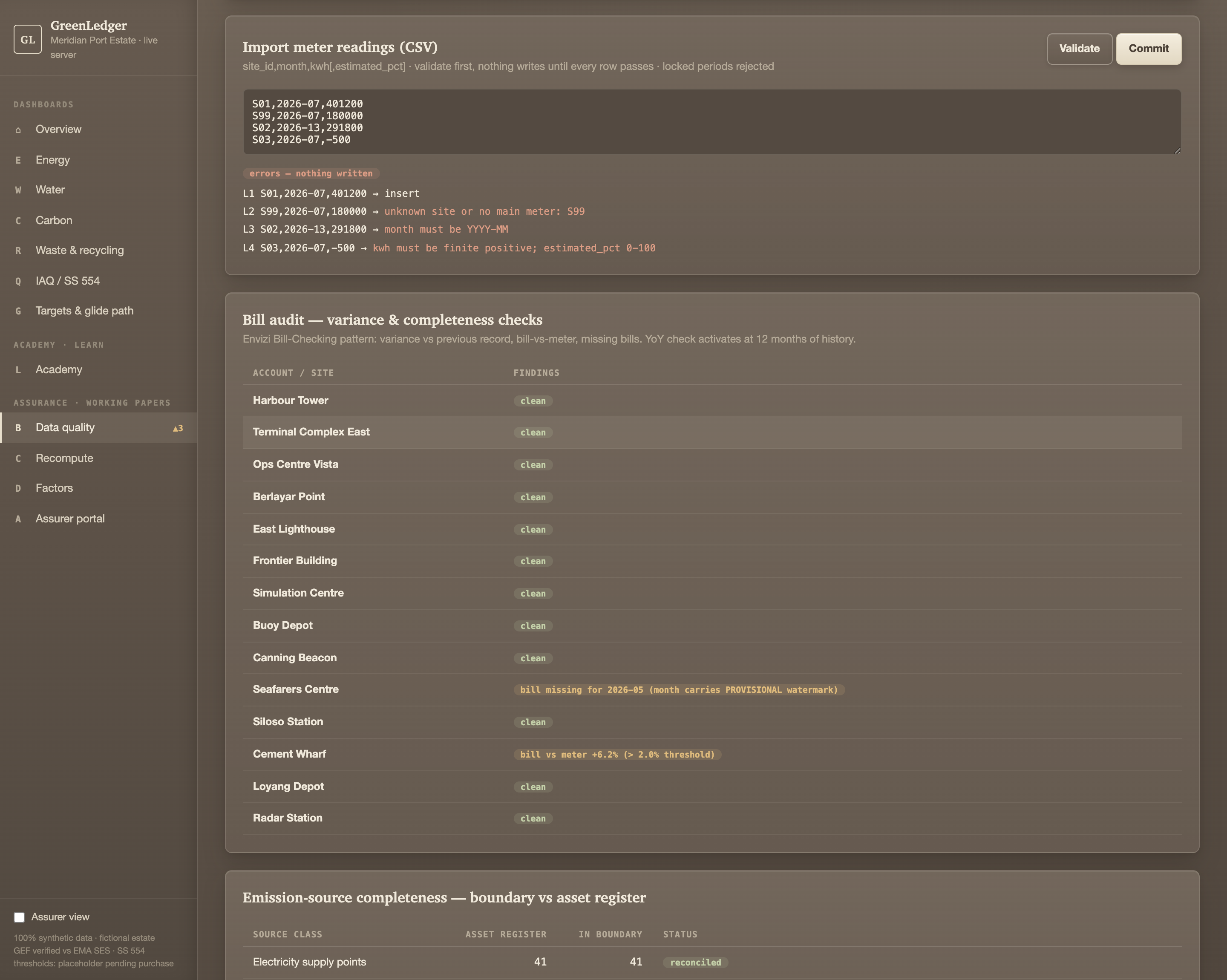
The incumbent grammar is enterprise CRUD, and its onboarding is a configuration project: Microsoft's own documentation walks new Sustainability Manager customers through eleven dependency-ordered milestones and tells them to expect "a few months" to a first scenario. Measurabl documents template-and-upload collection with no in-app validation for bulk uploads; errors come back by email on a five-business-day service level. [Microsoft Learn and Measurabl help centre, as documented, verified Jul-Aug 2026] Against that, a platform that seeds and computes immediately, and validates every row in-app at paste time, amounts to a different shape of product.

CSV import validation refusing a faulty file: per-row verdicts name the unknown site, the invalid month and the negative reading, and nothing is written
Exhibit 8. Validation is per line, instant, and all-or-nothing: errors mean nothing is written.
Meridian Port Estate · synthetic data · GreenLedger local build, Aug 2026 · the faulty file names its own errors; a five-day email loop does the same work in the incumbent pattern
THE CATEGORY, AS ITS OWN DOCUMENTATION DESCRIBES IT remove sample data organisation value chain reference data calculations import run validate allocation, goals… Eleven dependency-ordered milestones; the vendor's own guidance says to expect "a few months" to the first scenario, with a cross-functional team. Bulk-upload validation in the template-and-upload pattern: errors returned by human email, five business days. GREENLEDGER, MEASURED ON THIS BUILD seed the estate first computed number per-row validation, at paste time minutes, not months SOURCES: IBM ENVIZI DOCS · MICROSOFT LEARN (SUSTAINABILITY MANAGER) · MEASURABL HELP CENTRE VERIFIED JUL-AUG 2026 · DOCUMENTED BEHAVIOUR, NOT OBSERVED USABILITY
Exhibit 9. The category defers value by months; a first defensible number takes minutes.
Vendor-documented onboarding and validation behaviour vs the GreenLedger local build · sources named in the diagram

Where the market is strong, the comparison is stated as parity, on the vendor's own documentation: Workiva's row-level audit trail, factor source and formula per figure, is matched by the provenance drawer and recompute; its in-product external-auditor workflow is matched by the two-way review loop above. The honest deltas that remain, per-meter bulk regression, bill-image drill-through, a tariff engine beyond blended time-of-use, are logged in the project's parity register, and claims beyond the documented set are treated as unevidenced rather than unmet.

09 / What transfers

The method transfers to messy estates; the platform is the proof of judgement, not the product.

A fair question: this runs on a clean synthetic estate, and real clients run forty ERPs. What transfers is the control architecture (proposal, gate, ledger, recompute, abstain), the readiness diagnostic (run one disclosed figure through the self-test lens and see whether it re-derives), and controls design aligned to the IAASB's published expectations, deliverable on whatever platform the client already owns. The synthetic demo proves the judgement; the delivery record, a sensing layer across more than fifty government facilities, a ten-supplier command-centre integration, regulated delivery under MAS technology risk management, proves execution in environments where the result gets inspected.

The engagement types this maps to, in the order I would sell them: CSRD and ISSB readiness with a controls lens; pre-assurance self-testing before fieldwork; double-materiality workspace design with close-call documentation; and the whitespace almost nobody occupies yet, an AI-governance review of a client's existing carbon platform against the IAASB control-point specification.

THREE QUESTIONS FOR LEADERS

1. "If your assurer asked you tomorrow to re-derive one disclosed figure from evidence, could anyone do it without a spreadsheet archaeology project?"

2. "Where in your reporting stack can an AI output become a number without a named human approving it, and would the audit trail show you?"

3. "What share of your Scope 3 is modelled rather than measured, and given that modelled estimates run at roughly 111% error, what is your plan to shrink it?"

This platform is built and demonstrated; the interactive workbench runs in your browser, and the full platform walkthrough is available live on request.

Open the in-browser workbench →Read the evidence: the five pain points →The workbench runs entirely in your browser. GreenLedger itself is a local build, demonstrated live on request.

Sources and evidence labels

EFRAG, Cost-Benefit Analysis on the Draft Amended ESRS (December 2025)
Interpretation ranked first among burdens; 15% of internal cost on understanding the standards; 89% high or very high effort; median EUR 500k internal + EUR 300k external; 20% on double materiality; ~25% internal-to-external assurance effort (interviews). Verified 3-0 except the interview-based 25%, verified 2-1. Caveat: 43 Wave 1 survey respondents, self-selected, commissioned alongside a simplification consultation; figures are what respondents reported.
IFAC / AICPA & CIMA, The State of Play in Sustainability Assurance (FY2023 data)
82% limited assurance, ~8% reasonable, two-thirds of reasonable work GHG-only; non-audit providers 45% of reports, 38% applying ISAE 3000 vs 98% for audit firms. Verified 3-0. Caveats: superseded by the 2019-2024 edition (a planned revision of this piece will refresh these figures); the non-audit share has since receded to roughly 41%.
IAASB, ISSA 5000 and implementation guidance
Effective for periods beginning on or after 15 December 2026; until then engagements typically run under ISAE 3000 (Revised). The GL-interfacing carbon platform worked example, and the concession that entity controls "may often be less than fully developed". Verified 3-0 on source content; the extension to AI classifiers is stated as my inference.
Peer-reviewed data-quality literature
Scope 3 vendor agreement 68% within 1%; model-estimated data at 111% trimmed MAPE. Berg et al. on ESG rating divergence, 0.38-0.71, average 0.54. Scope 3 category coverage 3.75 of 15 average across 2010-2019 (rising, period-limited); FY2023 any-Scope-3 disclosure at 82% of GHG-reporting large listed companies, Category 1 at 65%. All verified 3-0 except the category average, verified 2-1 and historical.
Vendor documentation (labelled, not load-bearing)
IBM Envizi product documentation; Microsoft Learn, Sustainability Manager onboarding; Measurabl help centre; Workiva Carbon documentation. Verified against the vendors' own published documentation, Jul-Aug 2026; these describe designed behaviour, not observed usability. AI-effectiveness surveys published by tool vendors are excluded throughout per the negative finding in section 05.
Demonstration data
Meridian Port Estate: 100% synthetic, fictional estate, seeded faults declared as seeded. Fixed-seed build; re-running the seed reproduces the data, verdicts and hashes byte-identically. Test suite 40/40 at capture time (internal verification, not assurance). Factor values used in demo calculations cite their source and vintage or are explicitly representative synthetic.
CHANGELOG
2026-08-08 · First published. Exhibits captured from the live local build the same day.
Planned · Refresh IFAC figures when the 2019-2024 edition is incorporated; revisit the non-audit provider share.