In March a chiller plant uses 412,800 kWh. A clamp on its feeder measures the current, a sub-meter turns that into energy, the building management system logs it every fifteen minutes, someone exports the month into a spreadsheet, and the spreadsheet multiplies it by a grid emission factor. Months later the result is one line in a sustainability report. Nobody along the way did anything careless, and the number can still arrive wrong.
Until recently that was mostly a problem for the people who wrote the report. In Singapore every listed company has had to report Scope 1 and 2 emissions from FY2025, and in August 2025 ACRA and SGX RegCo moved the start of external limited assurance on those figures from FY2027 to FY2029 [1][2]. The IAASB's assurance standard, ISSA 5000, applies to periods beginning on or after 15 December 2026, and Singapore is adopting it locally as SSSA 5000 [3][4]. IFRS S2, on which Singapore's climate rules are based, asks companies to disclose their measurement approach, inputs and assumptions, and why they chose them [5]. All of this points at the same path. An assurer, like an auditor, starts from the reported number and walks back towards the meter.
The GHG Protocol reduces the arithmetic to one line: activity data times emission factor equals emissions [6]. The breaks sit in the hand-offs, and the explainer below follows that March reading through all five of them.
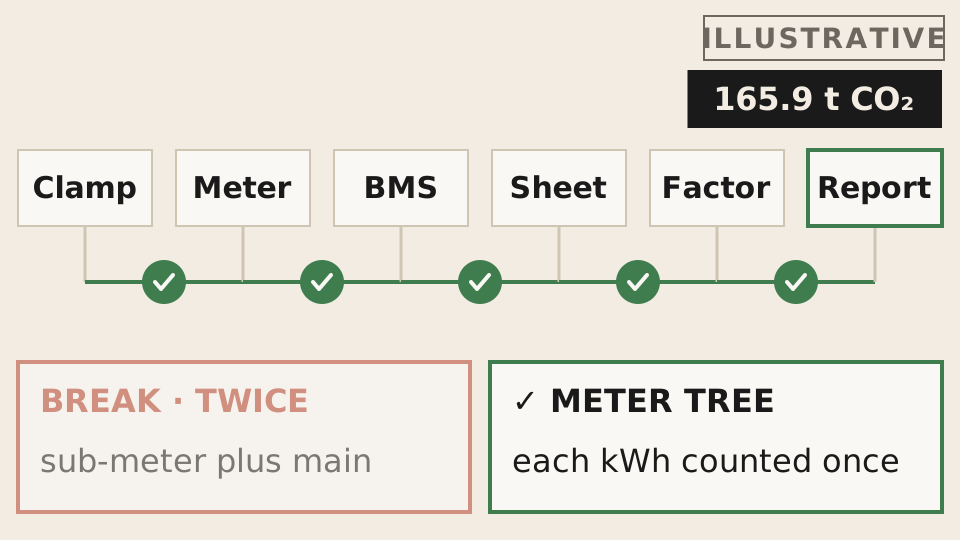
Five hand-offs, five breaks
Gaps, between sensor and meter. A gateway drops offline for three days. In a month of fifteen-minute logging that is 288 of 2,976 intervals, and the trend chart draws a neat line across the hole. If the month is summed from what arrived, the plant used 372,852 kWh, about a tenth less than it did. Gaps are normal, and even the settlement meters behind an electricity bill have them: Singapore's Metering Code fills runs of up to three hours of missing half-hour readings by interpolation, and runs of up to a day from a recent like day, before the data reach settlement [8]. The difference is that the code writes down how. The control is the same discipline applied inside the building. Count the intervals the calendar says should exist, fill any gap by a written method, and flag every filled interval so the estimate stays visible all the way to the report. In the explainer the fill lands at 412,640 kWh, close to the true figure but not on it, which is why the flag has to travel.
Units and multipliers, between meter and BMS. A current transformer's ratio is set in the meter at installation, and if it is entered wrongly every reading after that is off by the same factor. A register read in watt-hours and labelled kilowatt-hours is out by a thousand. The GHG Protocol's own quality checklist asks preparers to check that units are labelled and carried through the calculation, and to check the conversion factors [6]. My control here is reconciliation: compare the sum of the sub-meters with the main incoming meter or the utility bill every month, within a stated tolerance, and keep the CT ratio and units on the device register where anyone can check them. The tolerance has to respect the instruments. The Metering Code allows a low-voltage consumer meter of class 2.0 to read within 2.5% either way [8], and BMS sub-meters sit outside that code entirely, so their accuracy is whatever the building specified.
Estimates, between BMS and spreadsheet. The flag that marked the three filled days lives in the BMS. The export to the spreadsheet often carries the values and leaves the flag behind, and after a copy and a paste the estimated days look like measured ones. Nothing is wrong with estimating. IFRS S2 itself treats figures built from emission factors as estimates [5]. The problem is losing track of which parts were estimated. A locked extract with the flag as a column, and a line in the report giving the share of each figure that was estimated, keeps the estimate traceable.
Factor vintage, between spreadsheet and factor. The Energy Market Authority publishes Singapore's average grid emission factor each year. It was 0.412 kg CO2/kWh for 2023 and 0.402 for 2024, and the 2025 value had not been published when I wrote this [9]. Filled by the written rule, the month comes back as 412,640 kWh, flagged E, which gives 170.0 tonnes of CO2 under one factor and 165.9 under the other. A 4.1-tonne difference on one plant for one month is small, but it repeats across every meter and every month, and it is invisible if the factor sits in a cell with no source and no year. EMA's figure counts CO2 only, and EMA does not say which of its factors to use for Scope 2, so the choice belongs to the preparer and should be written down; IFRS S2 asks for the factors used to be disclosed [5]. A factor register fixes this: it holds the source, the year, the value and the date each factor was applied, and someone signs it off once per reporting period.
Double counting, between factor and disclosure. The chiller's sub-meter sits under the building's main meter. Add both to the total and the chiller is counted twice. Across companies the GHG Protocol is designed so that two of them cannot both report Scope 2 for the same purchased electricity [6], and within a company the same rule needs a picture: a meter tree, drawn once, with children subtracted from their parents and each kilowatt-hour assigned to exactly one reporting line. Market-based Scope 2 adds its own version of the problem, which the GHG Protocol's Scope 2 Guidance handles with rules on unique claims and a residual mix [7].
One more hand-off sits outside the chain. Owners of most commercial and institutional buildings of 5,000 m² or more must report a calendar year's electricity and other energy use to BCA under section 22FF of the Building Control Act [10]. Often the same meters feed both that return and the sustainability report. If the two disagree, someone will eventually notice, so the reconciliation belongs in the company's own monthly close.
Why the controls look familiar
I trained as a Chartered Accountant and Certified Internal Auditor, and none of these controls is new to anyone with that background. They are the financial-statement assertions applied to kilowatt-hours. Gaps are a completeness problem. Units and multipliers are accuracy. Estimates are closest to valuation, where the method behind a figure has to be disclosed. Factor vintage is closest to cut-off, a number applied to the wrong period. Double counting is occurrence, the same transaction recorded twice. Read that way, the evidence an assurer will ask for becomes predictable.
| Hand-off | What breaks | Control | Evidence to keep |
|---|---|---|---|
| Sensor to meter | Missing intervals summed as if complete | Interval count against the calendar; written fill method; E flag | Completeness report per meter per month |
| Meter to BMS | Wrong CT ratio, Wh read as kWh | Monthly reconciliation to main meter or bill, within a stated tolerance | Reconciliation with variances explained; register showing ratio and units |
| BMS to sheet | Estimates lose their flag | Locked extract with a flag column | Share of each figure estimated |
| Sheet to factor | Unlabelled factor from the wrong year | Factor register, signed off each period | Source, year, value, date applied |
| Factor to report | Child meter added to its parent | Meter tree and boundary rule | Tree diagram; list of netted-off meters |
The cost of finding a break late is written into the GHG Protocol. The Corporate Standard asks for the base year to be recalculated when a significant error is discovered, or when several small ones add up to something significant [6]. A unit error found in year three can mean restating the base year and every year since.
Two synthetic demos on this site show the assurer's side of the chain. The GHG Assurance Workbench recomputes each disclosed figure from activity data and a cited, versioned factor, and swapping one grid factor's vintage moves two metrics outside their tolerance. A disclosure that cites no factor at all gets Cannot-Verify instead of a guess. The Climate Disclosure Bench reads a report the way an assurer will, and the passages that survive are the ones with a boundary, a method and a data trail, including a frank paragraph on how much of the floor area was estimated.
The standards are still moving. The GHG Protocol consulted on a revised Scope 2 Guidance from October 2025 to January 2026, hourly matching drew low support, and the work went back to its technical working group in July 2026; a combined GHG Protocol and ISO corporate standard is planned for late 2028 [11]. None of that changes the five hand-offs. A meter tree and a factor register will be needed under whichever method wins.
Sources
- ACRA and SGX RegCo, Extended Timelines for Most Climate Reporting Requirements to Support Companies. www.acra.gov.sg (25 Aug 2025)
- ACRA, Sustainability reporting and assurance requirements, timeline. www.acra.gov.sg (updated 27 Jul 2026)
- IAASB, ISSA 5000, General Requirements for Sustainability Assurance Engagements, effective date and adoption status. www.iaasb.org (published 12 Nov 2024)
- ISCA, Exposure Draft SSSA 5000, General Requirements for Sustainability Assurance Engagements, public consultation. isca.org.sg (1 Oct 2025)
- IFRS Foundation, IFRS S2 Climate-related Disclosures, paras 29(a)(ii), 29(a)(iii), 29(a)(v), B22 and B29, December 2025 consolidated text. www.ifrs.org
- WRI and WBCSD, The GHG Protocol: A Corporate Accounting and Reporting Standard, Revised Edition, chapters 4, 5, 6 (Figure 10) and 7 (Table 4). ghgprotocol.org (2004)
- WRI and WBCSD, GHG Protocol Scope 2 Guidance, sections 6.11.4 and 7.1, Table 7.1. ghgprotocol.org (2015)
- Energy Market Authority, Metering Code, sections 2.4.32, 2.8.2 and 4.6. www.ema.gov.sg (Sep 2022)
- Energy Market Authority, Singapore Energy Statistics 2025, chapter 2, Grid Emission Factor. www.ema.gov.sg (updated 24 Oct 2025)
- Building Control Act 1989, section 22FF, Periodic reporting on energy use of Type 1 buildings, with the Building Control (Environmental Sustainability Measures for Existing Buildings) Regulations 2013, regs 2B and 3D. sso.agc.gov.sg (in force 30 Sep 2025)
- GHG Protocol, Scope 2 Public Consultation Feedback Summary, Executive Summary, and Key Standard Development Updates FAQ. ghgprotocol.org (29 Jul 2026)
Regulatory positions as of 18 October 2026. ACRA's consultation on SFRS S1 and S2 closes on 25 October 2026. Verify dates before relying on them.
Views are my own, not my employer's.