LIVE DEMO · SYNTHETIC OR PUBLIC DATA · PRESS RUN TO LOAD, 1.2 MBOpen full page →
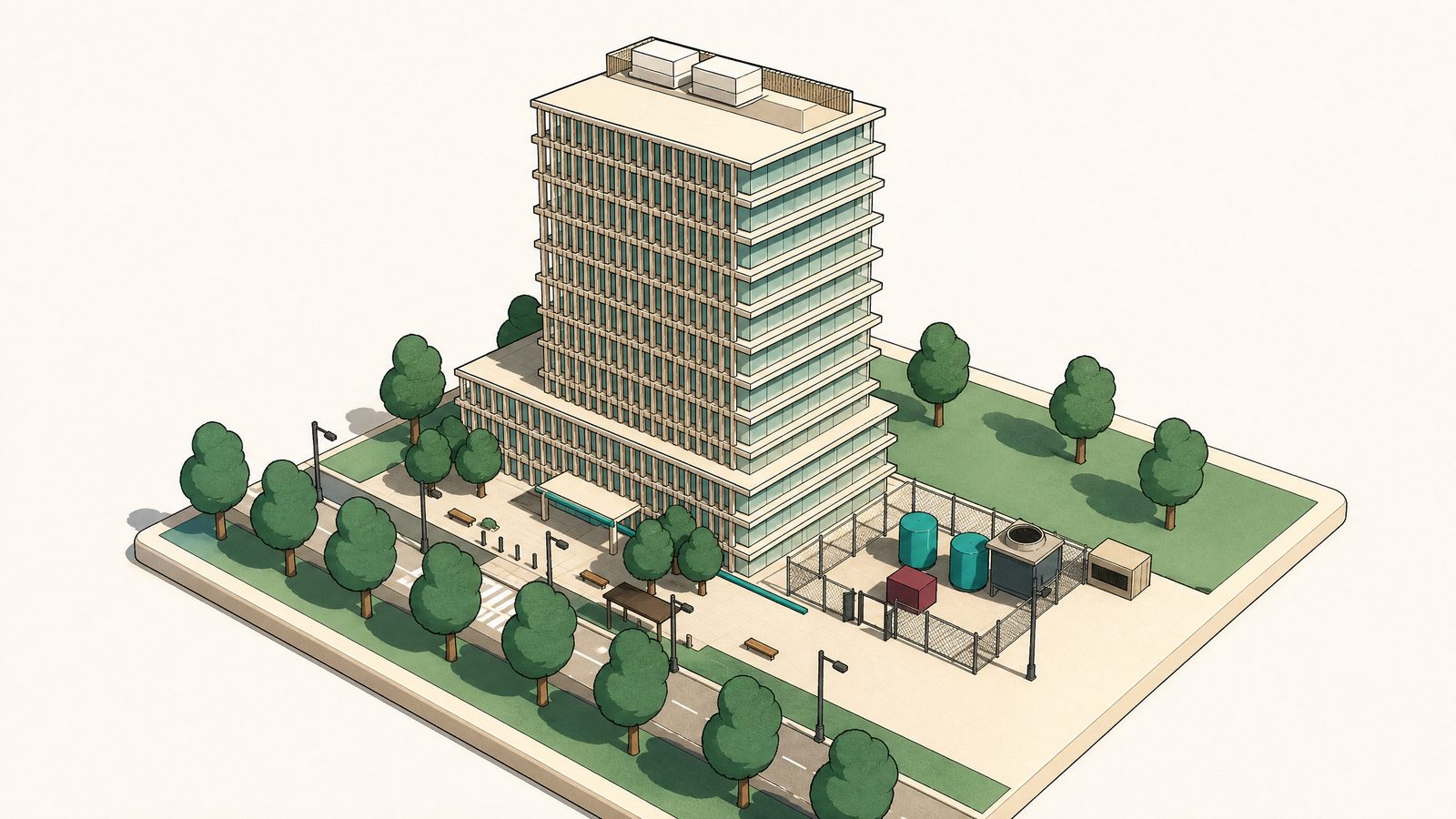
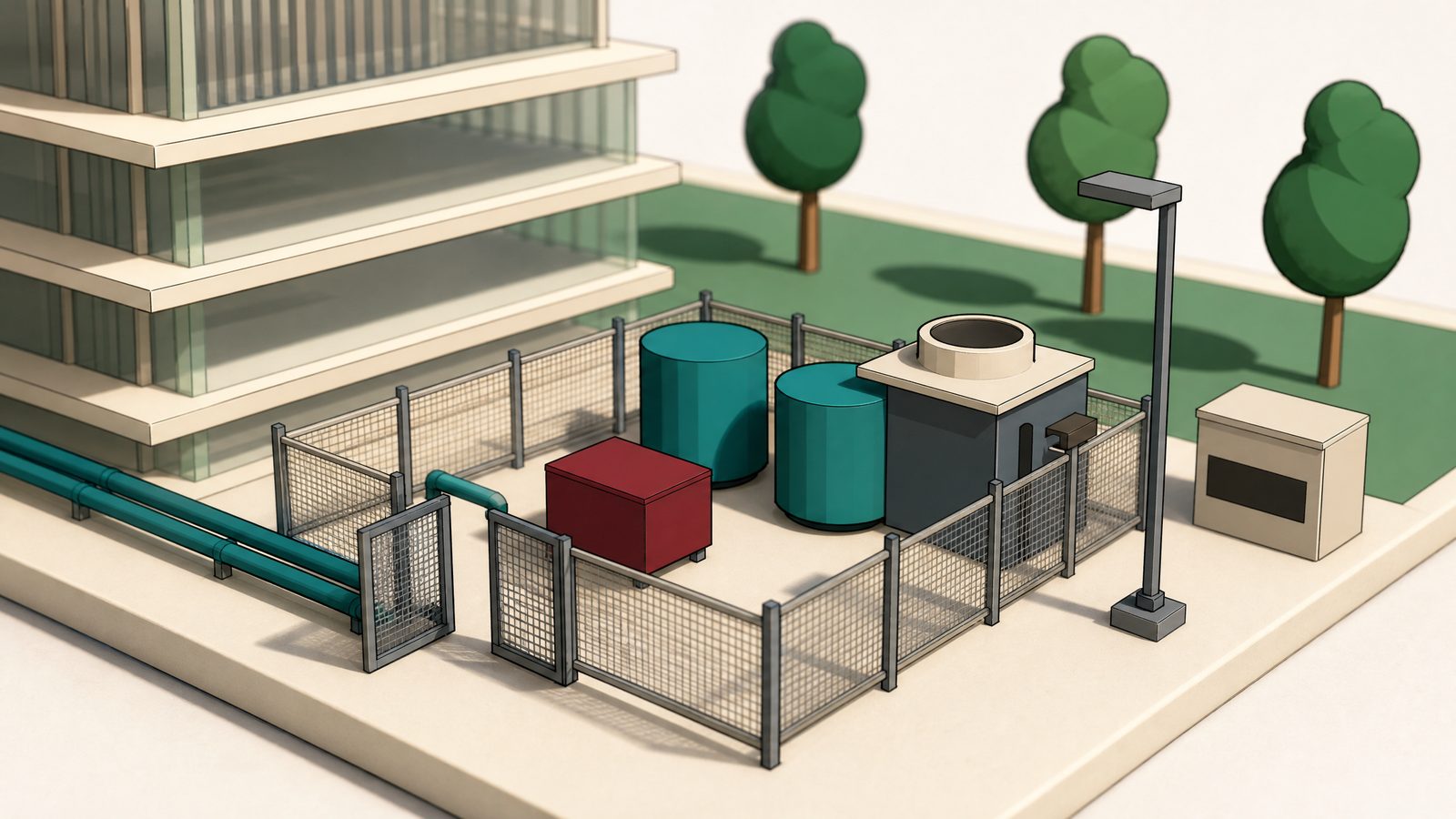
This is a stylised digital twin of a small estate: a twelve-storey block, its rooftop air handlers, its chiller plant, and the temperature, air-quality and power points that instrument it. You can orbit it, click any asset for live telemetry, inject a bearing fault into an air handler, and watch the consequence travel: the floors it serves warm up, the chiller strains to compensate, the rules catch it, the model proposes a diagnosis, and the work order stops at a named human. A second view reduces the whole estate to an abstract lattice, the same twin at minimum fidelity. Runs in your browser, well under a megabyte over the wire, light enough for a phone.
LIVE DEMO · SYNTHETIC OR PUBLIC DATA · PRESS RUN TO LOAD, 1.2 MBOpen full page →
This is the running twin, not a recording. Scroll back up and it resets. Scroll past the last step and you can orbit it yourself.
A twelve-storey block, its rooftop air handlers and a chiller yard. Forty-one instrumented points, every one synthetic.
Every floor count and footprint derives from one photograph, through the massing table in Part 3.
AHU-R1 vibration passes 7.1 mm/s. A threshold catches it, not a model.
The duct riser lights. This machine serves levels ten, eleven and twelve, and those three floors drift warm. No other floor moves.
CH-01 picks up load to 81 per cent to make up for the lost airflow. The chilled-water run turns amber.
Bearing degradation at 0.87, with the links it used shown. It proposes and stops.
Priority, SLA and cost come from rules and a rate card. The dispatch waits for a named approver, and every step is in the ledger.
For four years I have delivered estate technology where the result is a single operating picture: a S$35M programme integrating BMS, Power SCADA, security and fire systems into one command centre with a digital twin interface, and a 50+ facility refresh for a maritime estate with IoT sensing, a microgrid and an FM command centre. Those systems belong to their owners and cannot be shown. So I built a small one that can be. The geometry is schematic on purpose. What is real is the operating concept, because that is the part that matters and the part I have delivered at scale.
The digital-twin conversation usually begins with an expensive promise: model every duct in BIM, integrate everything, then get value at the end. Most building owners never make it past the first invoice. The asset-light twin inverts the order. Start from the points the estate already owns, its BMS registers, meters and sensors, put schematic geometry around them so a human can navigate, and spend the budget on the part that pays: detection rules, the work-order loop and the evidence trail. This is not a compromise position. The UK's national digital-twin programme made it a principle: a twin is judged on purpose, trust and function, and should carry only as much fidelity as the decision needs (the Gemini Principles, Centre for Digital Built Britain, 2018). Fidelity beyond that point is cost, not value.
That is also why this page loads in well under a megabyte and runs on a phone, while carrying the same operating loop I delivered at estate scale. When a fault is injected here, the duct riser that carries the consequence lights up before the floors do, because the twin knows which floors that air handler serves. Knowing the system topology is worth more than modelling its geometry.
To push the reduction to its logical end, the demo carries a second representation: press Lattice and the estate collapses into a stepped wireframe of its own massing, holding nothing but state, kind and rough location. The outline stays the building's own, so the eye never loses its bearings. Floors become bands, plant becomes rings and diamonds, and the flows between them become moving particles. Inject the fault and the same story plays out: the failed unit turns red, the bands it serves turn with it, and the flow lines carry the strain to the chiller. It is the same twin, the same rules and the same ledger, with every polygon that does not answer "what is broken, in what state, roughly where" removed. If the lattice still does the job, then everything the industry adds beyond it should have to argue its way back in.
The block derives from a single photograph, itself AI-generated for this site and unrelated to any client or real building, for copyright and confidentiality; every step of the method applies unchanged to a real photograph. The ground around it, the roads, trees and plinth, is declared scenery in a site plan and comes from no photograph. The picture was rebuilt in September 2026 (plinth, roads, trees, ink outlines, a tour), and the loop underneath it did not change. It is not a BIM model, not a client system, and not live building data: every reading is simulated and labelled as such, and the fault script is written by me. A production twin earns its keep on integration breadth (ten suppliers' systems speaking one language), data quality at the sensing layer, and the operating model around it, none of which a browser demo can prove. What a browser demo can prove is that I know what the picture has to show, where the human belongs in the loop, and what the evidence trail has to look like. The rest is the delivery record.
The twin is the visible part. The part I actually care about is underneath: rules detect, the model proposes with its confidence on display, a named person owns the consequential call, and the ledger remembers. That is the same spine as every other demo on this site, because that is what I believe an estate owner, or a lender's technical adviser, should demand of any system that claims to be intelligent.
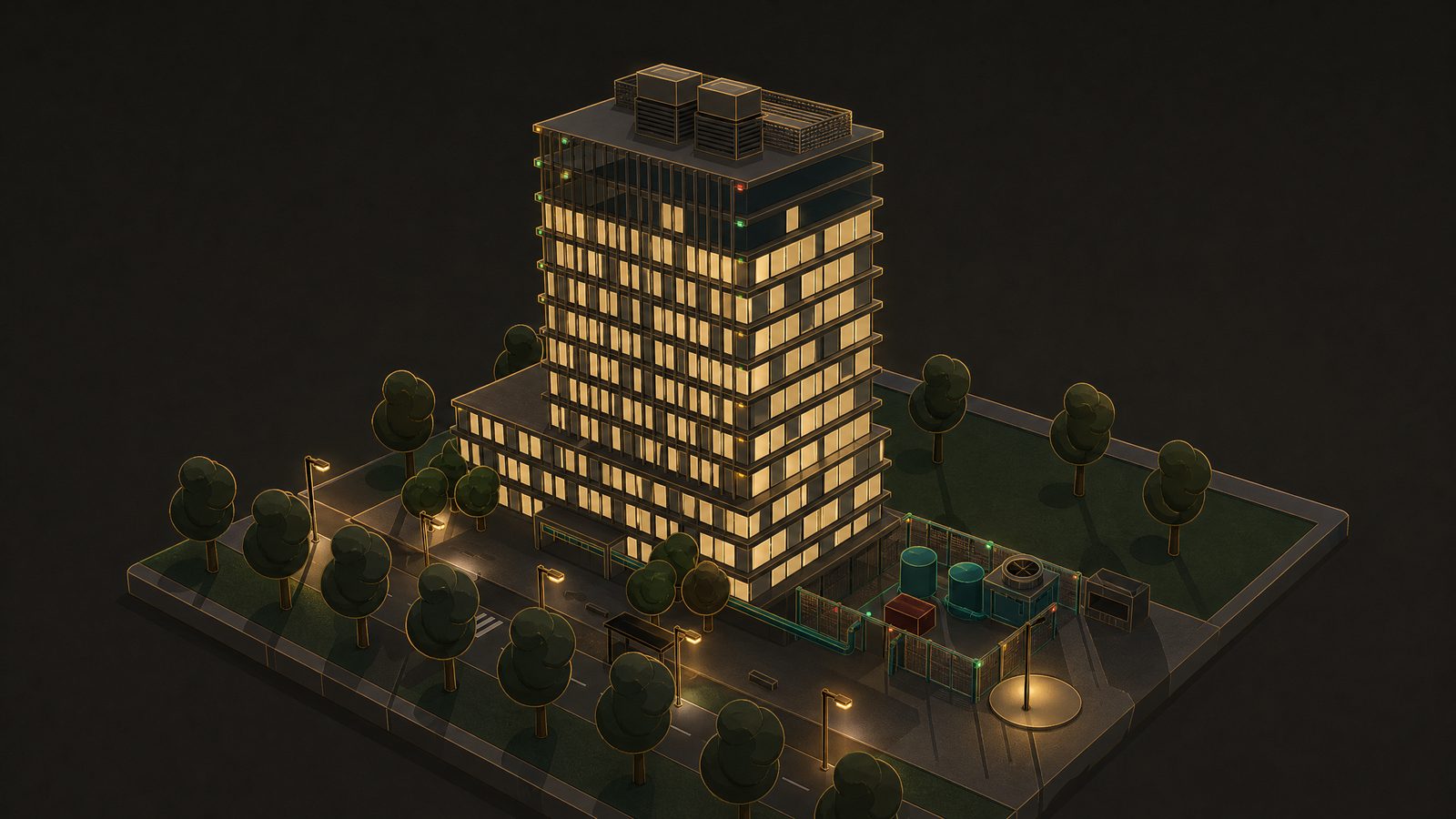
In September 2026 the renderer was rebuilt: a site plan for the ground and context, toon shading with ink outlines, a plinth, day and night lighting, a guided tour. Nothing the monitoring loop reads changed. The three images below were made from screenshots of that twin with an image model, so the site can carry a picture that looks finished without pretending the building is real. Any photographic-looking still of this estate on this site is AI-rendered from a screenshot of the twin.